February 10, 2026
 min
min


Receivables management isn’t simply a question of good admin. It’s a key business tool for financial health and stress-free growth. Overdue payments can weigh heavily on cash flow, so looking at accounts receivable examples from across Europe can offer some effective tips. Several European countries have set up noteworthy systems, some of which can be adapted to different companies.
Germany: contractual rigour as a guarantee
In Germany, late payments are an exception. With an average payment term of just six days[1], German companies are some of the best payers in Europe. This discipline rests on a strict approach to commercial relationships: every contractual agreement is rigorously respected.
Terms of payment are non-negotiable once they are agreed. Payment reminders are seen as a standard structured process and not an inconvenience. A company not paying on time knows that this will immediately be taken into account. This pragmatism keeps cash flow healthy and prevents unnecessary friction.
[1] An average payment term of 12 days, André Letowski, MMA Foundation for future entrepreneurs, 2023.
France: predictable payment terms and structured dispute resolution
In France, extended payment terms are the norm, with the average agreed term of up to 60 days, despite the standard being 30 days.While French commercial law sets a legal maximum of 60 days, late payments remain widespread, with over 80% of companies experiencing delays, particularly SMEs.
To address this, French businesses tend to rely on structured receivables management processes and proactive dispute resolution. Companies closely monitor client accounts, send reminders ahead of deadlines and implement escalation procedures for overdue invoices.
If late payment persists, French companies can turn to the Médiateur des entreprises, a mediation service offering a framework to resolve payment disputes before they escalate to legal action. Transparency, clear contractual terms and early engagement with debtors are central to maintaining predictable cash flow and healthy business relationships.
The Netherlands: a pragmatic approach to receivables management
In the Netherlands, receivables management relies on deterrence. The ability to file a bankruptcy petition against a debtor for late payment encourages faster payments.[1]. Although this might seem radical, this deterrent can play a role in getting invoices paid on time.
It’s an effective approach that also requires rigorous tracking. Dutch companies tend to place a focus on preventing late payment with proactive risk analysis and systematic payment reminders before the invoice payment deadline.
[1] Debt recovery in The Netherland : filing for bankruptcy, Kasia Durlik, Village de la justice, 2021.
Italy: proactive receivables management
In Italy payment terms are often longer than elsewhere in Europe, [1] especially in certain industries. Rather than dealing with constant overdue invoices, some companies rely on particularly proactive payment reminder systems.
The accent is on prevention and tailoring the conversation according to client profiles. Reminders are sent before the payment deadline and communication is structured to maintain an open dialogue. Personalising payment reminders according to client payment habits optimises the chances of quick payment.
[1] Late payment: Commission refers Italy to Court of Justice for failing to ensure suppliers are paid on timeEuropean Commission, 2017.
Automate and structure your receivables management with Clearnox
Structuring your contracts, sending professional reminders, adopting digital tracking tools and improving deterrence measures can all help to improve your receivables management and secure your cash flow.
Setting up processes inspired by international accounts receivable examples may seem ambitious, but technology today means you can automate and optimise receivables management without adding to your finance team’s workload.
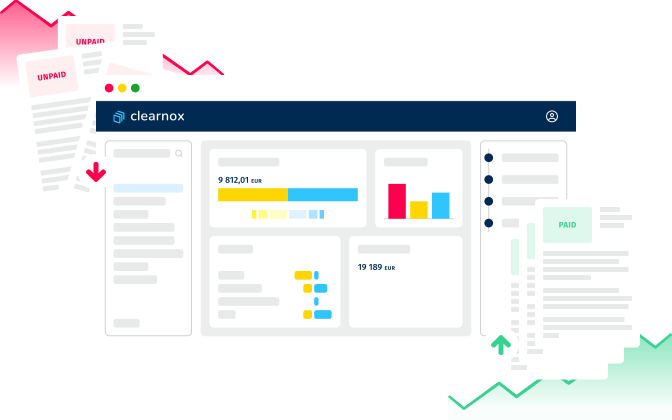
With Clearnox, companies can track their receivables in real time, automate payment reminders and personalise their communication according to client profiles. Forewarned is fore-armed, cash flow is protected and commercial relationships are preserved.
Book a demo and find out how to optimise your receivables management and secure your cash flow with Clearnox.
-
 Share
Share